Royal United Hospitals Bath

Emergency Department / A&E

We are located in A&E (map)

Map of Hospital location in Bath


Services

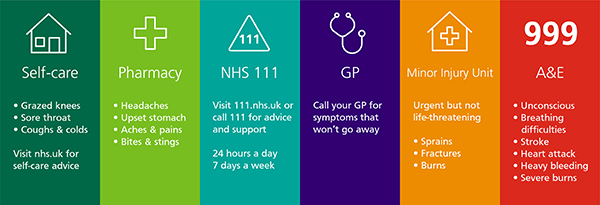
If have an urgent need to see a GP or nurse, but your illness or injury is not life‑threatening, please call or visit the Urgent Treatment Centre.

High demand in A&E – please consider your healthcare options

Our A&E department is really busy at the moment. If your injury is urgent but not life threatening you may want to consider attending a minor injuries unit instead:

  • Paulton Minor Injuries Unit (open 8:00am to 7:00pm)
    Full details
  • Chippenham Minor Injury Unit (open 8:00am to 8:00pm)
    Full details
  • Trowbridge Minor Injury Unit (open 8:30am to 4:00pm)
    Full details

MIUs are run by experienced clinicians and are available to treat non-life-threatening injuries, such as: sprains and strains broken bones minor burns and scalds. If your injury is urgent but not life threatening you may want to consider attending a minor injuries unit instead.

Think 111 First

If you need medical help but it's not a 999 emergency you can contact NHS111 on the NHS111 web site or on the phone before travelling to hospital for urgent and emergency care. Find out more about NHS 111 below.

Suspected stroke? Act F.A.S.T.

Check the symptoms here. If you suspect a stroke, call 999.

Suspected Stroke? Act F.A.S.T.  A stroke is a medical emergency that requires immediate medical attention. So recognising the signs of stroke and calling 999 for an ambulance is crucial.

F – FACE: Has the person’s face fallen on one side? Can they smile?
A – ARMS: Can the person raise both arms and keep them there?
S – SPEECH: Is the person’s speech slurred?
T – TIME: Time to call 999 if you see any single one of these signs.

Other Sources of Assistance

Other sources of assistance
Other sources of assistance

Pharmacists

Pharmacists are experts in medicines and can also help with minor health concerns, such as coughs, colds, sore throats, tummy trouble and aches and pains.

  • Pharmacists are trained medical experts
  • Many pharmacies have a quiet area where you can talk to a Pharmacist in private
  • You don't need to book an appointment to see a Pharmacist

Find your local pharmacy and opening hours.

Dentists

If you think you need urgent dental treatment, contact your dentist. If you cannot contact your dentist or don't have one, use the NHS 111 service. If needed, urgent appointments will be arranged at an out of hours service.

NHS 111

Think 111 First

The national Think 111 First programme asks people in need of urgent health care to contact NHS 111, on the NHS111 web site or by phone, before travelling to hospital for urgent and emergency care.

So if you have an urgent medical problem, and you are thinking about going to our Urgent Treatment Centre or Emergency Department, please contact NHS 111 first.

The 111 service will assess your needs and direct you to the most appropriate local service.

Frequently asked questions

How and when can I access NHS 111?

NHS 111 is available 24 hours a day, 7 days a week.

To get help from NHS 111, you can:

  • visit to 111.nhs.uk (for people aged 5 and over only)
  • call 111 for free from a landline or mobile phone (all ages)

What is Think 111 First?

Think 111 First is a national programme which asks people to contact 111 first if they are thinking about going to the Urgent Care Centre (UCC) or Emergency Department (ED) for an urgent, but not serious or life-threatening, health problem.

You will be directed to to the most appropriate local service. This could be your GP, pharmacist, the Urgent Care Centre or the Emergency Department (ED).

Isn't NHS 111 just an information line?

NHS 111 is much more than information line – it helps to get people to the right service for their health needs, first time.

NHS 111 can arrange appointments at GP surgeries, some minor injuries units and urgent treatment centres - as well as send an ambulance should the person's condition be serious or life-threatening.

What if I turn up to the Emergency Department without calling 111 first?

If you visit our Emergency Department without having called NHS 111 first, you will still be seen.

However, patients with more critical or life-threatening conditions will be prioritised and those whose conditions are not as urgent may need to wait or will be directed to another service for treatment.

Calling 111 first will ensure that you get quicker care in the right environment, so please consider calling 111 first, the next time you have an urgent medical problem.

What are the benefits of calling 111 first?

  • You will be able to speak to a senior medical professional earlier and get the right treatment, first time.
  • If you are assessed as needing an urgent face-to-face assessment or treatment, this can be arranged immediately - leading to shorter waiting times for all patients.
  • By advising people where and when to go, we can control queues in our Emergency Department waiting rooms.

Patients in A&E

Help us to help you

To help the staff to assess and treat you, please tell them about:

  • Any previous health problems you have had
  • All drugs and treatments you are currently using
  • Allergies
  • Any recent overseas trips
  • If you are pregnant or breastfeeding    
  • Any other facts you think they should know about

Check in

On arrival in the emergency department you will be asked to go to the reception desk to provide our reception staff with your address details which will enable us to book you onto our computer system.

This enables us to provide your GP with a letter summarising your attendance and also to access stored helpful information such as previous A&E notes, ECGs or notes on patients with specialist medical conditions.

Patients who arrive by ambulance or are very unwell will have their details logged on by the ambulance staff, though if relatives are accompanying the patient we will often ask them to provide the details as this enables the ambulance staff to assist in the immediate care of the patient

Triage

Your treatment starts as soon as you step into the Emergency Department (A&E). On arrival, you see a specialist emergency nurse called the triage nurse. The triage nurse assesses how serious your condition is.

This is a very important first step in the treatment process and ensures that even in a large department with many separate treatment areas we can ensure the most unwell patients with life threatening conditions are seen promptly.

Please tell the triage nurse if you are in pain as we are always able to provide some pain relief while you are waiting to be seen.

Waiting for treatment

After seeing the triage nurse, you may be asked to wait in the waiting room. The waiting time depends on how busy the department is at the time, and the number of patients with life threatening conditions.

Sometimes the waiting area can seem quiet, but this doesn't mean the A&E is quiet - the most sick patients will enter through the separate ambulance entrance and be taken straight into the resuscitation or high care area - understandably neither of these are visible from the waiting room.

We understand that being in the A&E can be stressful and waiting can be frustrating.  Please be assured that we take the best possible care of all our patients and do our best to keep your wait to a minimum and make you comfortable. If you feel your condition has changed please let the reception staff or triage nurse know.

Other medical practitioners

As part of your assessment it may become apparent that your care is best provided by another healthcare professional, this is particularly the case for problems which have been occurring for a significant period of time or have already discussed with your GP.

If this is the case we may arrange a specific appointment with your GP or our on site out of hours general practitioner service - this is done to provide the best level of care for all patients and to enable the treatment of patients who would otherwise have a long wait time while more acute cases are seen.

Code of behaviour

A code of behaviour exists to ensure a safe and friendly environment for patients, visitors and staff. No acts of violence, swearing, threats or verbal abuse towards another patient, relative or staff member are allowed. An initial warning is given, but if the behaviour carries on, the staff, security or the police will ask the person to leave.

Safe guarding valuables

It is best to ask a friend or relative to look after your valuables while you are being treated in the A&E. Despite efforts by hospital staff, theft remains an issue. The hospital will only take responsibility for items that have been formally receipted for safekeeping by security.

Visitors in A&E

Visitors in A&E

If you feel it is necessary, you can bring one other person with you - a partner, family member friend or carer, when you attend our Emergency Department.

We are following social distancing guidelines and, as a result, have less space in our Emergency Department waiting room.

At busy times, we may ask that the person accompanying you temporarily waits elsewhere until we are ready to assess you.

Patients with a physical or mental disability who cannot attend alone or those under the age of 16 do not need to attend alone.

Code of behaviour

A code of behaviour exists to ensure a safe and friendly environment for patients, visitors and staff.

No acts of violence, swearing, threats or verbal abuse towards another patient, relative or staff member are allowed. An initial warning is given, but if the behaviour carries on, the staff, security or the police will ask the person to leave.

About our A&E

We are a busy UK Emergency Department. We provide emergency care to a large catchment population of around 500,000 people in Bath, and the surrounding towns and villages in North East Somerset and Western Wiltshire. Our dedicated highly skilled staff strive to provide the very best care for patients in an environment that is challenging, but fun to be part of.

The department was rebuilt in 2003 and to reflect the demands of high patient volume and level of care required, takes its model from that of many American trauma centres

The nature of our location often requires longer ambulance transfer times and the care of very unwell patients - reflected in our high admission rate (40%).

We have an extremely good working relationship with our inpatient teams, and many patients referred to the specialities will be assessed in the emergency department, and all patients arriving through the department who are assessed to be unwell and needing immediate medical input, are given prompt treatment and stabilised before leaving the A&E.

There is a large resuscitation area with fully equipped bays for 4 patients including a dedicated paediatric resuscitation area including equipment for newborn resuscitation, all areas have an overhead gantry for portable emergency X-rays.

Ambulances attend via the dedicated ambulance entrance and are met on arrival by the nursing co-ordinator before being allocated to an appropriate clinical area. The nursing and doctor workstations are in the centre of the department to improve observation and patient care.

The department has a separate high care area with 6 monitored beds for the care of more unwell patients or those requiring continuous cardiac monitoring. Our majors treatment area has a further 18 cubicles including a private examination room and an isolation cubicle.

Adjacent to the majors/high care area is our minors treatment area, this has a mixture of seated and trolley assessment areas, with separate assessment areas, treatment and procedure rooms and a dedicated plaster room and eye injury assessment room.

We also have an allocated paediatric assessment area, with its own separate waiting area including play/change facilities and separate assessment cubicles.

The emergency department has its own dedicated X-ray department providing 24hour digital X-ray facilities.

As part of our department there is a separate A&E observation ward, this an 8 bedded area where we provide care for patients who require an extended period of observation but are likely to be discharged home, for example those with head injuries, thereby reducing the number of unnecessary hospital admissions.


Contact us

Opening times:
The RUH Emergency Department is a 24-hour, seven day a week walk-in service. This means you do not need to book an appointment.

Phone: 01225 824391


Going home

When you are discharged from the A&E, you are given advice about follow-up care. This may include: Instruction sheets, drugs & prescriptions, appointments for further tests or Outpatient appointments

We can provide information regarding public transport services to the hospital, out of hours  relatives may be required to help transport patients home or our reception staff can assist with patients who wish to call taxis.

As with the rest of the country there is very limited hospital transport for patients and this includes those who have been brought to hospital by ambulance - there are simply not enough vehicles to attend all the 999 calls and then transport those patients home. It is therefore the responsibility of patients to be able to get themselves home.


Emergency Department / A&E


▲ Back to Top